
|
Recycle, Reuse, Rejoice!

|


Officials Propose Adding Unique Marine Mammal to Endangered Species List
Only 150 Hawaiian False Killer Whales Remain in the Wild
LOS ANGELES (November 17, 2010) – In a move to save the dwindling population of the Pseudorca crassidens—better known as the insular Hawaiian false killer whale—the Obama Administration today proposed classifying the population as an endangered species under the Endangered Species Act.
“The whales are losing their food, getting hooked on fishing lines and accumulating toxins at a rate that threatens their survival,” said Michael Jasny, Senior Policy Analyst of NRDC’s Marine Mammal Project. “Protecting them will go a long way towards protecting the extraordinary marin
e environment of the Hawaiian Islands.”
Video of the Hawaiian false killer whales are available here:
The Hawaiian false killer whale is a small and ecologically unique population that has suffered a significant decline over the last 25 years and, according to recent analysis by the National Marine Fisheries Service (NMFS), only 150 of the animals may be left. Last month the NMFS released a 230-page report concluding that the population stands “at a high risk of extinction.”
“Today’s announcement recognizes the serious situation the Hawaiian false killer whales face due to a series of manmade threats,” said Sylvia Fallon, wildlife biologist with NRDC. “Toxic chemicals, reduced food sources and interactions with fishing vessels continue to harm this unique mammal. Endangered species status will give the population a chance to recover.”
This decision comes one year after NR
DC submitted a formal scientific petition to list the population. Should the administration follow through on its proposal, the Hawaiian false killer whale would become only the fourth U.S. whale or dolphin population to appear on the endangered species list since 1970.
Under the endangered species listing, the government would have to identify critical habitat for the population, ensure that activities do not jeopardize its survival, and prepare a “recovery plan” to bring it back from the brink.
Background on the Hawaiian False Killer Whale
Hawaiian false killer whales are large members of the dolphin family. Females can grow up to 15 feet and males can reach 20 feet. In adulthood, false killer whales can weigh up to 1,500 pounds. They are pelagic animals that tend to prefer deep, open water, and the Hawaiian inshore population is the only one of its entire species known to make its home near land. This indicates not only the uniqueness of the population, but also the biological importance of Hawaiian waters as an oasis for marine mammals.
Research shows that Hawaiian false killer whales establish long-term bonds within their species, sometimes mating for up to 20 years. They also display unique feeding habits that promote trust among members of their pod by passing prey back and forth with fellow hunting partners before consuming the catch.
The population faces a number of threats including interactions with local fisheries, reduced food sources and exposure to toxic chemicals. It is likely that the whales are affected by both long-line and unregulated near-shore and “short” long-line fisheries. A recent study showed that disfigurement from fishing gear in this population was four times higher than for other
dolphin and toothed whale species around the islands, suggesting high rates of interactions with fisheries. These fisheries may also be contributing to a decline in the size and number of the primary food source for false killer whales: large, deep-water fish including mahi mahi and yellowfin tuna.
The cumulative effects of these risks combined with the population’s dangerously small size qualify it for listing under the federal Endangered Species Act. NRDC petitioned to list the Hawaiian false killer whale as an endangered species in September 2009. Granting of endangered species status would extend a special level of protection to the whales and their habitat in order to help the population rebound.
Recent population surveys of the insular population of Hawaiian false killer whales shows a precipitous decline in size over the past 10-20 years. In 1989, more than 300 individuals were seen in aerial surveys compared to more recent population estimates of 150 individuals.
The National Marine Fisheries Service will have one year from today’s proposed rule to issue a final rule designating the Hawaiian false killer whale as a federally protected endangered species.
Recycle, Reuse, Rejoice!

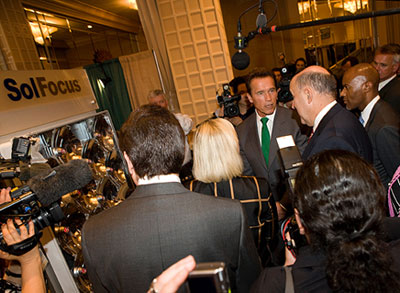
"How many times do you have to get hit on the head with a 2x4 before you decide to take action?" asked George Shultz.Harrison Ford took the stage after the Governor, easily following in the footsteps of Climate Action Hero. He has been a long supporter of and spokesperson for Conservation International whose main message at the summit is the carbon cost of deforestation. "Sixteen percent of all global greenhouse gas emissions is created from deforestation. That's more than all the buses, cars, trucks on the planet combined," said Ford.

Bjorn Lomborg and Ondi Timoner's approach to the Macro Theme of Global Climate Change is simple: Dollars & Cents
"I support the carbon tax," said filmmaker Ondi Timoner in a recent interview with Greening Hollywood. "It's only 6 cents at the gas pump and it would raise $270 Billion." Money, she says, that could be used to fund R&D of new clean energy sources and also green jobs.
The best way to silence someone is to destroy their reputation," said Timoner.
Cool It! the documentary about Global Climate Change that opens in major U.S. markets today, follows scientist and professor Bjorn Lomborg as he discusses the issues of global climate change with experts around the world. This Dane is the editor of the book Smart Solutions to Climate Change, and the author of The Skeptical Environmentalist, which The Guardian U.K. says are two very different outlooks on the same issue by the same person.
In his new book, Lomborg concludes, "Investing $100bn annually would mean that we could essentially resolve the climate change problem by the end of this century."
In his own defense, Lomborg explained to Greening Hollywood in a telephone interview that, "My fundamental point is not that we shouldn't worry [about climate change]. It's that we need to be led by good information, good judgment. We have to keep asking How big is the problem? And not focusing only on people who shout the loudest or have the cutest animal. We have to worry about [climate change] in the smartest possible way so that we end up doing a lot of good. Not just feeling good."
Ondi Timoner, a Sundance Kid, whose previous documentaries "We Live In Public," and "Dig!" very candidly admitted that she knew very little about the issue of climate change when she first met with Lomborg to discuss the for-hire film project.
About that first creative meeting, Timoner recalled, "I didn't know if Bjorn was legitimate or not but I grilled him for five hours. He expressed his ideas in such interesting ways that when I left that meeting I was convinced that he was worth hearing; he was worth knowing about. The best way to silence someone is to destroy their reputation," said Timoner.
"I was also overwhelmed by the subject matter. I felt challenged to make climate change an entertaining subject matter, not so dry. I saw that after 18 years of climate change conferences there was no forward motion. I wanted to make a movie where I could engage the audience so they feel empowered to do something."
One point that Timoner and Lomborg agree on is that there's a need for solutions when it comes to the Climate Change debate. They both recognize that there's a polarization between the left and the right and their approaches to Climate Change. Lomborg, a scientist who has become comfortable with and around cameras in recent years, has a good response that just might cut to the quick of that polarization:
"Think forward to our kids and grandkids...It doesn't matter if we've spoken beautifully about climate change. It matters if we have done something about it." - Bjorn Lomborg





 Posts
All Comments
Posts
All Comments


 Posts
All Comments
Posts
All Comments


